DIY Electrical Work: What You Can (and Can't) Do Yourself
DIY electrical work is safe only for a short list of small, like-for-like jobs, such as replacing a standard switch or cover plate, done with the circuit breaker off and the wires tested dead. New circuits, panel work, aluminum wiring and anything that smells, buzzes or scorches belong to a licensed electrician. Permit rules vary by state and city, so check locally first.
This guide is general information, not professional advice. Electrical work can cause shock, burns and fires. Laws and codes differ by location, and the National Electrical Code (NEC, published by the National Fire Protection Association as NFPA 70) is enforced in all 50 states, but NFPA says states often enforce older editions and some cities enforce their own locally amended version, so check which one applies where you live. When in doubt, hire a licensed electrician.
What electrical work can a homeowner safely do?
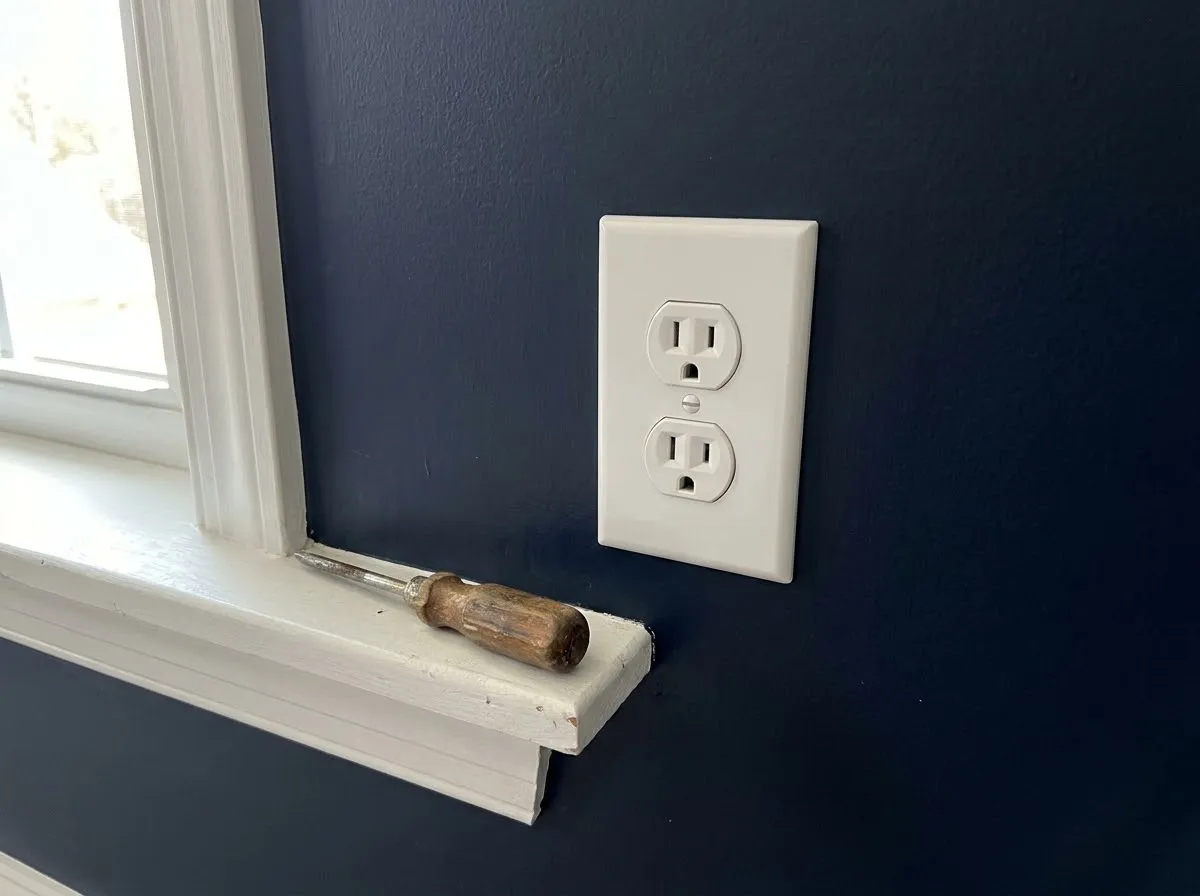
The Electrical Safety Foundation International (ESFI) strongly recommends hiring a qualified, licensed electrician for any electrical work in your home, and says most homeowners lack the training or experience to do it safely. It also publishes safety tips for people who decide to DIY anyway. The advice below stays within that cautious line.
A homeowner can safely handle small, like-for-like jobs on an existing circuit: replacing a cover plate, a standard single-pole switch or a basic receptacle, or swapping a light fixture on an existing box. Every one of these starts the same way: the breaker is off and the wires are tested dead.
“Like for like” means the new part matches the old one in type, rating and wiring. A 15-amp single-pole switch replaces a 15-amp single-pole switch. The moment you change the circuit, add a device, or find wiring that does not match what you expected, the job moves up the risk ladder below.
Safe DIY also depends on the condition of your house. A job that is simple in a 2005 home with copper wiring and a ground wire can be a hazard in a 1970s home with aluminum wiring or a box with no ground.
The electrical risk ladder: DIY, permit, or pro
Think of electrical jobs in three tiers. The tier tells you how much skill, paperwork and inspection a job needs. Our companion guide on knowing your limits and when to call an electrician has a job-by-job table.
Tier 1: DIY with the power off and tested dead
These jobs involve no new wiring. ESFI says permits are generally not mandated for minor repairs, such as replacing a receptacle where one already exists, but confirm locally:
- Replacing a cover plate or a worn standard switch like for like (see the step-by-step light switch guide).
- Replacing a standard receptacle with the same type, when the wiring is copper and in good condition.
- Replacing a light fixture on an existing, properly supported box.
- Changing light bulbs and plugging in or replacing a lamp cord plug.
Tier 2: permit usually needed, and many owners hire a pro
Work that adds or changes wiring is where permits and inspections come in. ESFI lists a new circuit, a hot tub, and a receptacle or light fixture where none existed among the projects that require a permit. For the others below, ask your building department:
- Adding a new outlet, light or circuit.
- Installing a ceiling fan where there is no fan-rated box or wiring.
- Installing recessed lights, an EV charger, a hot tub or a generator connection (many owners hire a pro for these).
- Moving a switch or outlet to a new location.
Where owners may pull their own permit, this is the tier where the inspection matters most. Where they may not, you need a licensed contractor.
Tier 3: licensed electrician only
- Anything at or inside the service panel, including replacing breakers or upgrading the service.
- Repairing aluminum branch-circuit wiring or old knob-and-tube wiring.
- Wiring that is damaged, scorched, buzzing or hot.
- Work in wet locations or outdoors beyond replacing a fixture or device like for like.
Do you need a permit for electrical work?
Permit rules vary by state and by city, so the only reliable answer comes from your local building department or state licensing board. Some states let owners work on their own homes under a homeowner permit, while others do not, and a city can be stricter than its state.
Two examples show how different the rules are:
- South Dakota. The state’s Department of Labor and Regulation says you must have an approved homeowner permit before starting any electrical work. The exemption covers only a residence or farmstead that you own and live in, not rentals, and the work needs a rough-in inspection before walls are closed and a final inspection.
- Washington. The Department of Labor & Industries says owners should buy a permit only if they will do the work themselves, strongly encourages hiring a licensed contractor, and tells you not to cover electrical work before it is inspected. Permits are good for one year.
Treat these as examples, not a rule for your area. If you hire a contractor, the contractor normally pulls the permit, and you should confirm they are licensed.
Why bother? ESFI says many state and local laws require a permit before wiring or devices are installed, and an inspection to confirm the work was done safely and meets code. We cannot give legal advice, so ask your local authority.
What are the warning signs of unsafe wiring?
The U.S. Consumer Product Safety Commission (CPSC) lists hot-to-the-touch face plates on receptacles or switches, flickering lights, circuits that do not work, and the smell of burning plastic at outlets or switches as signs of electrical system problems in its aluminum wiring guidance, and says to have a qualified electrician determine the cause and not to try to fix it yourself.
ESFI adds dim and flickering lights, unusual sizzling and buzzing sounds, and circuit breakers that trip repeatedly to the list and says to contact a qualified electrician immediately. It estimates home electrical fires cause about 51,000 fires, nearly 500 deaths and $1.3 billion in property damage a year, and says electrical distribution systems are the third leading cause of home structure fires.
If you see or smell any of these, switch off the circuit at the breaker if you can do so safely, leave the area alone, and call an electrician. If you see smoke or flames, leave the building and call 911.
Failing connections can also give no warning. CPSC notes that failing aluminum-wired connections seldom show easily detected signs, which is why age and wire type matter as much as symptoms.
Is my house wired with aluminum?
Homes built from about 1965 to the mid-1970s may have aluminum branch-circuit wiring, and CPSC found that aluminum-wired homes built before 1972 were 55 times more likely to have outlet connections reach fire-hazard conditions than copper-wired homes. Aluminum wiring is not a DIY repair.
You can look at the printed markings on the cable jacket in an unfinished basement, attic or garage. Cable marked “Al” or “Aluminum” is aluminum. Cable marked “CU-clad” or “Copper-clad” is copper-coated aluminum and is not covered by CPSC’s repair recommendations. If you cannot tell, have an electrician identify it.
CPSC approves only a few permanent repairs: complete replacement with copper, the COPALUM crimp method, and the AlumiConn connector method. All three are electrician work, and CPSC highly recommends hiring a qualified electrician for them. Devices rated for copper only, such as the standard switches sold at hardware stores, must not be connected to aluminum wire.
What tools do you need for DIY electrical work?
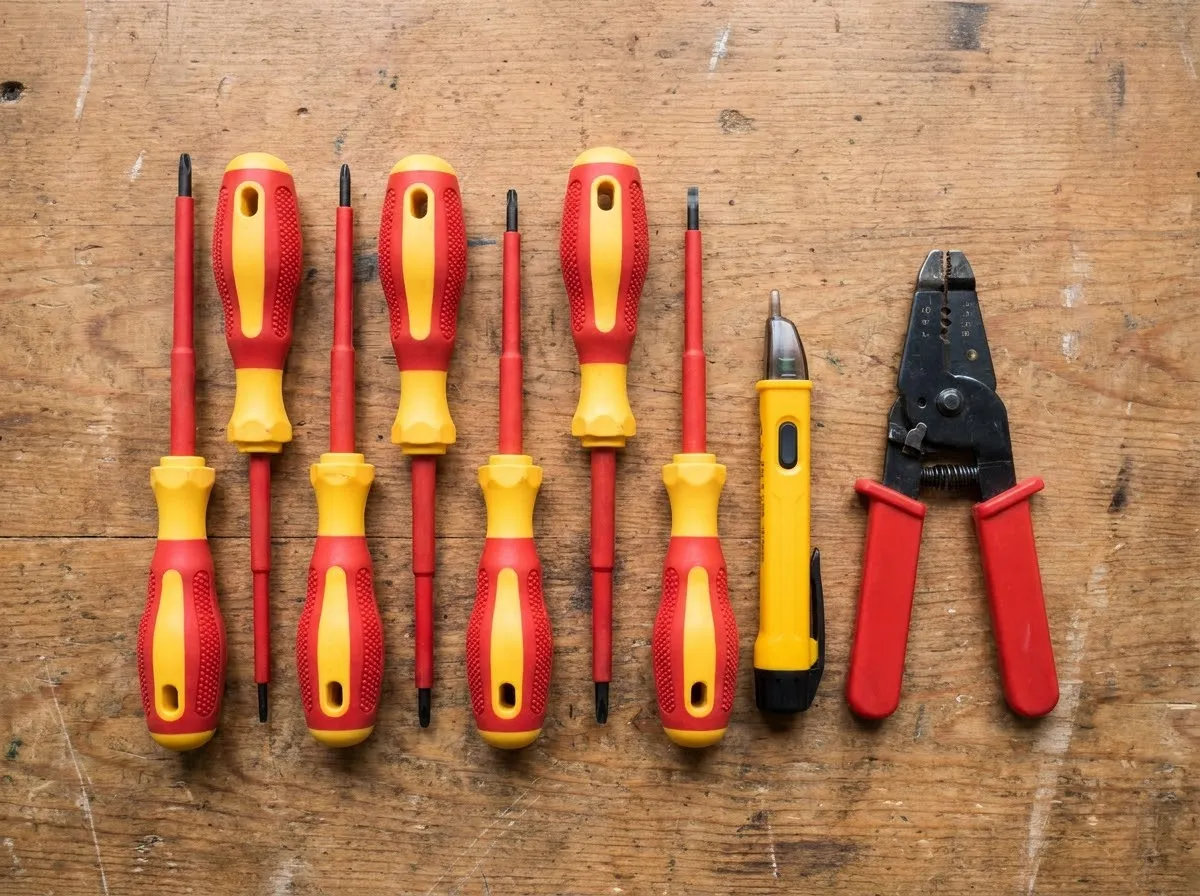
A basic kit is a non-contact voltage tester, a multimeter, insulated screwdrivers, a wire stripper, needle-nose pliers, a flashlight or headlamp, and wire connectors. The testers only help if you use them in the right order. The home repair tool kit guide shows where electrical tools fit in a starter kit.
Non-contact voltage tester
A non-contact voltage tester (NCVT) is a pen-style tool that beeps or lights up near a live wire. Use it as a first screen only. Klein’s instructions say to verify operation on a known working circuit before and after each use, warn that a no-voltage indication does not mean voltage is absent, and say the tester will not detect voltage in a shielded wire and may miss it in other conditions the manual lists. Read the manual for your model.
Multimeter
A multimeter measures voltage, so it can be used to check the wires at the device. Fluke advises using a known voltage source or proving unit to verify the meter is working properly before you rely on it. Check yours on a known live source before and after, and read its manual for the right setting and its safety rating. If you have never used one, ask a competent person to show you.
Other tools
Use insulated-handle screwdrivers, a stripper marked for the wire gauge, and the strip length printed on the device. Leviton’s standard switch, for example, calls for about 5/8 inch of insulation removed for back-wiring and about 3/4 inch for side wiring, with terminal screws tightened to 14-18 inch-pounds. Always follow the sheet that comes with your device.
What should you check before you start any electrical job?
Check four things before you buy parts: the wire type, the condition of the insulation, whether the box has a ground wire, and whether you can identify every wire. If any answer is “no” or “not sure”, the job is no longer a beginner job.
- Wire type. Look for copper. Aluminum or copper-clad aluminum needs a pro, as above.
- Insulation. Brittle, cracked, scorched or cloth-covered insulation means stop.
- Ground. A bare copper or green wire in the box. If it is missing, do not improvise: the manufacturer’s instructions and local code decide what is allowed, and an electrician can tell you the right fix. Lutron’s guide, for example, says the NEC permits a replacement control without a ground in the box only under specific conditions, such as using a non-metallic faceplate with non-metallic screws or protecting the circuit with a GFCI.
- Ratings. The device’s amp and voltage rating must match the circuit. Standard residential switches such as Leviton’s 5601 are 15-amp, 120/277-volt devices.
Take a photo of the wiring before you disconnect anything, and label wires with tape. This costs nothing and saves mistakes.
The right order: de-energize, verify, then work
The only safe order is: turn off the breaker, test that the power is off, then work. Device manufacturers say the same thing. Leviton’s instruction sheet says to turn off power at the circuit breaker or fuse and test that the power is off before wiring, and Lutron’s install guides say to turn off power at the breaker or fuse before installing.
- Identify the circuit and switch off its breaker. Tell everyone in the house, and tape a note on the panel.
- Prove your non-contact tester on a known live source, then remove the cover plate and test the wires with it. Test every wire in the box, since a box can hold more than one circuit.
- Remove the device and test the wires again. ESFI says to test from the black wires to the grounded box and to the white wires, and from the white wires to the grounded box. Use a multimeter you have checked on a known live source, and re-check your tester afterward.
- Stand on a dry floor, never touch plumbing or gas pipes (ESFI), and never rely on a switch being “off” as proof.
- Restore power only after the device is mounted, the plate is on, and tools are out of the box.
If any test shows voltage you did not expect, stop. Do not continue until a licensed electrician has found why.
Which smart devices and upgrades are safe to DIY?
Smart switches are a step up the ladder because many need a neutral wire. Lutron says its Claro smart switch requires a neutral connection. Some switch boxes have no neutral wire, so check the box before you buy.
If you open the box and find no white neutral wire, or wires you cannot identify, stop and check the product’s instructions. Wiring a neutral in often means running new cable, which is electrician work. The light switch guide covers the full list of when not to DIY.
When should you hire a licensed electrician?

Hire a licensed electrician when a job adds wiring, touches the panel, involves old or damaged wiring, or you are not certain what you are looking at. Hiring a pro is not a failure. It is the correct decision for most electrical work.
Hire a pro if:
- You cannot turn the power off and prove it is off.
- The box has aluminum wiring, no ground, scorched or brittle insulation, or cloth-covered wires.
- The job needs a permit and your area does not allow owners to pull one.
- You smell burning or feel heat at a plate or outlet.
- You need a new circuit, a panel change or a service upgrade.
Ask for the electrician’s license number and verify it with your state licensing board. Ask who will pull the permit, and get the quote in writing.
Where does electrical work fit in your DIY and budget plans?
Electrical work is one part of a larger repair and upgrade plan, and it is the part where cutting corners costs the most. Build a realistic budget that includes a licensed electrician for anything above Tier 1.
For other repair skills, start with the DIY home repair for beginners guide. For planning what to spend on, see budget home improvement: where to spend and where to save. A sensible plan often has you doing the painting and fixture swaps while a pro handles wiring, which keeps the safe savings and avoids the risky ones.
Our two electrical guides
- Home electrical projects: understanding your limits and when to call an electrician: a comparison table of common jobs sorted into DIY, permit usually needed, and pro only.
- How to install a light switch: a like-for-like single-pole replacement, step by step, plus the cases where you should stop.
All Electrical Basics guides
- How to Install a Light Switch: Replace a Single-Pole Switch Safely
Learn how to install a light switch: replace a single-pole switch step by step with the breaker off, plus when to stop and call an electrician.
- When to Call an Electrician: DIY Limits for Home Electrical Projects
Know when to call an electrician: a job-by-job table of what is DIY-ok, what usually needs a permit and what is pro-only, plus warning signs.
Questions and answers
Can a homeowner do their own electrical work?
Often yes, but only within limits that vary by state and city. South Dakota and Washington, for example, let owners do their own work under a permit and inspection, and ESFI notes that many state and local laws require permits and inspections for wiring work. Even where it is legal, ESFI strongly recommends a licensed electrician. Check your state licensing board and local building department before you start.
What electrical work can I do myself?
The safest jobs are replacing a cover plate, a standard single-pole switch or a basic receptacle like for like, and swapping a light fixture on an existing box, always with the breaker off and the wires tested dead. Anything that adds a circuit, changes the panel, or involves old, damaged or aluminum wiring should go to a licensed electrician.
Do I need a permit to replace a light switch?
It depends on where you live. ESFI says permits are generally not mandated for minor repairs such as replacing a receptacle where one already exists, but that many state and local laws require a permit for adding a receptacle, light or circuit. Rules for switches vary, so call your local building department and ask before you start.
What electrical jobs should never be DIY?
Leave service panels, breaker replacement, service upgrades, new circuits, aluminum wiring repairs, knob-and-tube wiring, and work in wet or outdoor locations to a licensed electrician. OSHA notes that a panel is not de-energized just because its disconnect is open, since the supply side stays powered. Also stop for scorch marks, buzzing, hot cover plates, or a burning smell, and call a pro.
Is a non-contact voltage tester enough to prove power is off?
No. A non-contact tester is a first check, not final proof. Klein's instructions say to verify the tester on a known working circuit before and after each use, warn that a no-voltage indication does not guarantee there is none, and say it will not detect voltage in a shielded wire. Then test the wires at the device with a multimeter that you have also checked on a known live source.
Can I turn off one breaker and work on any outlet?
Only after you prove it. Do not rely on panel labels, and remember that one box can hold wires from more than one circuit. Flip the breaker, then test every wire in the box before you touch it, and again at the device. If the tester shows voltage anywhere, stop, find the other circuit, and turn it off too.
How much does an electrician cost compared with DIY?
Rates vary widely by region, job size and whether a permit is involved, so there is no single national figure. Small repairs and new circuits are priced very differently. Get two or three written quotes. The money saved by DIY on a risky job is rarely worth the fire, shock or insurance risk.
What are warning signs of unsafe wiring?
The Consumer Product Safety Commission lists hot-to-the-touch face plates on receptacles or switches, flickering lights, circuits that do not work, and the smell of burning plastic as signs of electrical system problems. ESFI adds dim lights, sizzling or buzzing sounds, and breakers that trip repeatedly. CPSC says to have a qualified electrician determine the cause and not to try to fix it yourself.
Our sources
- ESFI: DIY electrical safety (esfi.org)
- ESFI: Home electrical fires facts and statistics (esfi.org)
- Leviton Decora 5601/5603 single-pole and 3-way switch installation sheet (leviton.com)
- U.S. CPSC Publication 516: Repairing Aluminum Wiring (cpsc.gov)
- South Dakota Department of Labor and Regulation: Homeowner wiring permits (dlr.sd.gov)
- Washington L&I: Purchase electrical permits and request inspections (lni.wa.gov)
- Lutron Caseta Claro smart switch installation guide (assets.lutron.com)
- ESFI: Do-it-yourself (DIY) electrical safety tips (esfi.org)
- ESFI: Home Electrical Safety workbook (permits, testing wires before touching) (esfi.org)
- Klein Tools NCVT-7 non-contact voltage tester instructions (data.kleintools.com)
- Fluke: Guide to digital multimeter safety (fluke.com)
- NFPA: Understanding NFPA 70, National Electrical Code (NEC) (nfpa.org)
- OSHA letter of interpretation, 2006-07-28 (work in electrical panels; supply side of a disconnect) (osha.gov)
- OSHA 29 CFR 1910.333: Selection and use of work practices (testing to verify de-energized) (osha.gov)
Related reading
- When to Call an Electrician: DIY Limits for Home Electrical Projects
Know when to call an electrician: a job-by-job table of what is DIY-ok, what usually needs a permit and what is pro-only, plus warning signs.
- How to Install a Light Switch: Replace a Single-Pole Switch Safely
Learn how to install a light switch: replace a single-pole switch step by step with the breaker off, plus when to stop and call an electrician.